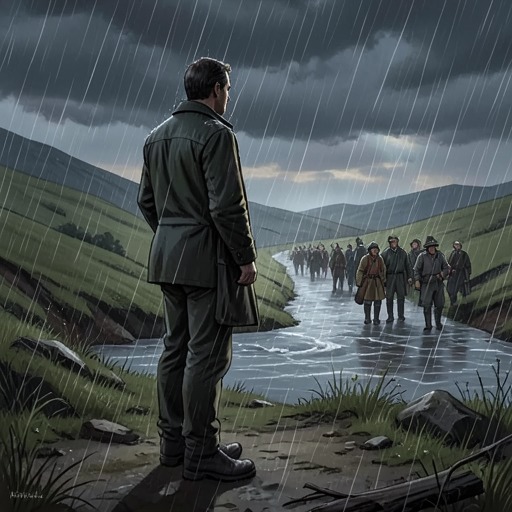
“Acceptance”
Dark Lies the Island“Acceptance” is the narrator’s chosen name for a hard-won response to uncertainty: not confidence that circumstances will improve, but a commitment to meet whatever comes. It emerges while floodwaters are still rising and no rescuers are visible, turning immediate danger into a wider reckoning with mortality, exile, illness, love, children, and the possibility of having no poems at all.
The word in the flood
With the water continuing to rise, the narrator experiences a sudden clearing of perspective. At forty, he concludes that he must learn the rigours of acceptance and deliberately capitalizes the word, making it a principle rather than a passing mood. He lists radically different possible futures—a watery grave in Ireland’s only natural fjord, a return to the city, exile in a Cambodian swamp, poems or no poems, children or no children, lovers or none, illness, success or its absence—and commits to accepting whatever lies ahead until his death.
The resolve does not make the danger disappear. The flood remains an active threat, and the absence of people in high-visibility clothing underscores that no rescue is arriving at that moment. Instead, the narrator’s shift concerns how he will face what cannot be settled in advance. Its force lies in the breadth of the list: acceptance must extend not only to catastrophe but also to uncertain outcomes in art, family, intimacy, health, and work.
From insight to action
The narrator’s response to this realization is immediate and practical: electrified, he searches for a notebook. The gesture links acceptance to the prospect of writing. Poems appear in the list as something that might or might not exist, not as a guaranteed consolation; the notebook search shows that uncertainty does not prevent him from acting on an impulse to record or make something.
The scene then moves from private recognition into the hotel’s communal celebration. People dance, while Mick Harty holds napkins to his bleeding neck and the narrator joins the floor, closing his eyes as images of childhood pets appear against his eyelids. Acceptance is thus voiced amid danger, injury, festivity, and involuntary memory, rather than in an isolated moment of calm. The surrounding contradictions keep the principle from becoming a simple claim that everything is well.
A principle set against other responses
Elsewhere, the novel places Irish and English identities into sharp contrast. In conversation with a woman he has walked back to her aunt’s flat on Kentish Town Road, a man describes Ireland as magical and England as ironical; the distinction charms them both and precedes a passionate kiss. That exchange frames place as something encountered through competing sensibilities, while “Acceptance” faces the possibility of returning to the city or being exiled elsewhere without pretending that the alternatives feel identical.
The phrase “the mainland campaign” provokes a different response. Steven carries a light guitar case through London toward Camden, while Manus warns him not to become emotional and insists that he must keep a clear head. Steven objects to the language because it seems to erase those outside the mainland’s implied centre; Manus rebukes the objection as precisely the kind of emotion that threatens clear thinking. This argument is not the narrator’s acceptance, but it supplies a pointed contrast: where Steven challenges a political label that makes people disappear, Manus demands control of feeling in order to act. The principle of acceptance does not itself answer that conflict; it gives the narrator a way to confront what is put before him without claiming that naming or judging circumstances no longer matters.
Circumstances that cannot be mastered
The novel’s other lives make the range of what must be endured concrete. Evan the Head is recalled as a mysterious figure from Swansea, first met in a rough Cork pub where shootings had occurred and dealing and feuds were part of its reputation. He sells the narrator acid, shows him passports held under three names, and talks repeatedly about orgies and occult books. The account presents a history of unstable surroundings and reinvention rather than a settled identity.
Elsie and Suze, meanwhile, are described as Leeds-Irish women with family connections in south Galway. Their father had been imprisoned for striking their mother unconscious with a slap hammer; the sisters were turned away when they sought help from Galway cousins. Years later, they meet Evan in Galway, and the narrator recalls his wealth from bringing in a trawler’s cargo of grade-two Moroccan resin. The account says that one of the sisters had become pregnant by him, though it leaves which sister unspecified. Elsie says her relationship with Evan is over while still calling him a wonderful father. Her distinction between former lovers and a valued father is one of the novel’s clearest concrete instances of living with an untidy reality rather than reducing it to a single verdict.
A later scene gives acceptance a more immediate, uncomfortable shape. Tee-J has little choice but to join Patrick in the van rather than walk along the dual carriageway. He has spent ten minutes in silence, but the Mullaneys cannot sustain the silent treatment; the exchange turns to an insult about a badger and Patrick’s agreement. The moment offers neither reconciliation nor a resolution of their circumstances. Instead, the movement from constrained choice to familiar banter shows how an impasse can give way to renewed contact without ceasing to be an impasse.
Narrative significance
“Acceptance” is not a promise that loss, danger, or injustice can be made agreeable. Its defining scene names death alongside ordinary and intimate uncertainties, then turns the narrator toward his notebook while the water is still rising. That conjunction gives the word its tension: acceptance means relinquishing the demand for certainty, not denying the conditions that make certainty impossible.
Across the novel’s contrasting situations—from the narrator’s flood-bound reckoning to disputes over political language, fractured families, unstable identities, and strained companionship—the principle remains an orientation rather than a universal solution. It can hold open the possibility of acting, writing, or continuing in the face of unknown outcomes, while the surrounding scenes retain their differences in power and consequence. The narrator’s capitalized word is therefore both personal commitment and a measure of how varied the novel’s characters’ responses to circumstance can be.